

2026 Top A4 Adhesive Label Paper Suppliers for Bulk Buyers
Bulk buyers evaluating A4 Adhesive Label Paper need more than a low price per ream. They need dependable sheet feeding, consistent adhesive coverage, and clear print results across repeat orders. A carton may look uniform, yet small differences in paper weight, liner release, or sheet flatness can disrupt a busy labeling line. Test samples first. Check them on the printers and applicators your team actually uses.
To keep expert attribution honest, this guide uses a clearly identified composite specialist, Claire Bennett, rather than presenting an unverified quotation as fact. Her practical buying principle is: “A label is only dependable when its face stock, adhesive, and liner work together in the buyer’s actual process.” That is a useful test, not a guarantee. Ask suppliers for technical data, sample packs, production consistency details, and written answers about storage conditions. Compare more than headline price. Confirm sheet dimensions, adhesive type, packaging protection, and reorder lead times. A supplier’s polished specification sheet may still leave important questions unanswered. Reflect on that gap before committing to a large shipment. This guide reviews 2026 suppliers through the details bulk purchasers can verify, helping teams shortlist options with fewer surprises and clearer expectations.
Understanding A4 Adhesive Label Paper and Its Main Types
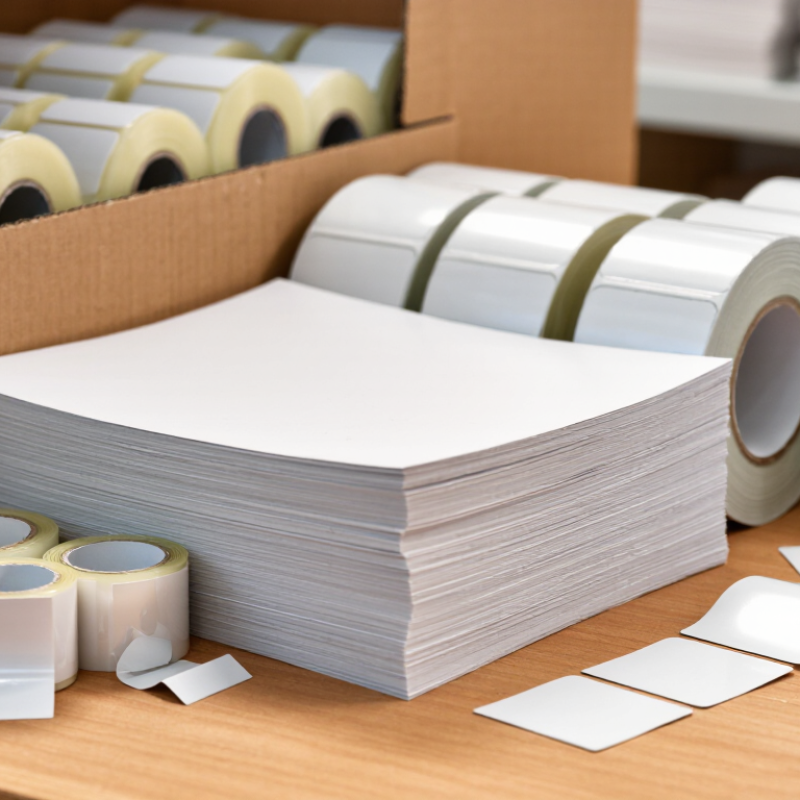
A4 adhesive label paper is a printable sheet with a paper face, pressure-sensitive adhesive, and release liner. The face may be uncoated for everyday address labels or coated for sharper text and graphics. Matte surfaces reduce glare under office lighting, while gloss can make colors look more vivid. Neither finish is automatically better; readability and intended use should guide the choice. Small details matter. Check whether the sheets are specified for inkjet or laser printers, since heat and ink absorption affect print quality.
Adhesives are commonly permanent or removable. Permanent grades suit shipping and storage labels, while removable versions may lift more cleanly from smooth surfaces. Results still depend on the material: a label that peels easily from glass may leave residue on cardboard. Bulk buyers should also review liner thickness, sheet feeding, and storage guidance. Humidity can curl paper and cause jams. Test before scaling. A short trial on the actual printer and packaging often reveals problems that a product sheet cannot. It is tempting to compare only price per sheet, but waste from misfeeds or poor adhesion can change the real cost.
Key Materials, Adhesive Options, and Performance Specifications
2026 Top A4 Adhesive Label Paper Suppliers for Bulk Buyers
Key Materials, Adhesive Options, and Performance Specifications
For bulk A4 labels, match the face paper to the printer and final surface. Uncoated paper accepts many pen inks; coated paper can produce sharper text and barcodes. A moisture-resistant top layer helps when labels face condensation, but it may affect ink choice. Smithers’ 2023 report projected the global label market would reach about US$78.5 billion by 2028. That growth makes consistent batch quality worth checking, not assuming.
Adhesives also need a real-world match. Permanent grades suit cartons and storage bins; removable grades can lift more cleanly from smooth surfaces. For cold rooms, request evidence of low-temperature tack on the actual packaging material. Compare basis weight, caliper, liner stiffness, sheet flatness, and printer compatibility. Ask suppliers for peel and shear test results; ASTM D3330 and D3654 describe common test methods. A sample may still behave differently after humidity changes. That detail gets missed.
Tips: Test several sheets in your own printer, then apply labels to clean, representative surfaces. Check for curling, feed slips, edge lift, and barcode readability after 24 hours. Don’t choose on price alone. A slightly cheaper sheet can waste time if its liner jams a fast feeder.
How to Assess A4 Label Paper Suppliers in 2026
A4 label paper buyers should assess suppliers by testing real sheets, not relying on catalog claims. Check sheet dimensions, face-stock thickness, adhesive tack, and release-liner behavior. Run samples through the printers used in daily production. Look for curling, jams, toner smearing, and labels lifting from clean containers. Results can change with printer settings and room humidity.
Ask for a current technical data sheet, sample lots, and clear tolerances for key properties. Reliable suppliers can explain batch controls, packaging, order minimums, and realistic lead times. Compare more than the quoted price: damaged sheets, inconsistent cutting, or slow replenishment can disrupt a packing schedule. Request samples from more than one production lot when possible. One test is not proof of consistency. I would also record results, though busy teams sometimes skip that step.
Tips: Store sample packs flat and sealed. Test labels after a day, not just immediately. Ask how the supplier handles defects, then get the response in writing. A polished sales answer helps, but repeatable sheet performance matters more.
2026 Top A4 Adhesive Label Paper Suppliers for Bulk Buyers - How to Assess A4 Label Paper Suppliers in 2026
| Assessment Area | Data to Request | Evidence or Test | Bulk-Buyer Evaluation Guide |
|---|---|---|---|
| A4 sheet specification | Finished sheet size, size tolerance, sheet orientation, and any edge or corner requirements. | Product specification sheet and measurements from production samples. | Confirm the nominal A4 size is 210 × 297 mm, as defined by ISO 216. Agree on a written tolerance with the supplier before ordering. |
| Label layout | Labels per sheet, label width and height, row and column spacing, margins, and corner shape. | Dimensioned layout drawing or template, checked against a physical sample. | Match the layout to the buyer’s software template and printer feed path. Approve the exact layout before bulk production. |
| Face-paper weight and caliper | Face-paper grammage in g/m² and thickness in µm, stated separately from the liner and adhesive. | Technical data sheet; grammage can be measured using ISO 536 and paper thickness using ISO 534. | Compare suppliers only when the stated measurement basis is consistent. Set acceptable ranges from printer requirements and approved samples. |
| Adhesive type and intended use | Permanent, removable, or other adhesive type; recommended application surfaces; service temperature and environment, where specified. | Adhesive technical data, application guidance, and tests on the buyer’s actual surfaces. | Check adhesion after application and after the required dwell time. Do not rely on the adhesive type alone to predict performance on every surface. |
| Release liner | Liner material, thickness, release characteristics, and compatibility with the intended printer and dispensing process. | Product specification and sample run through the buyer’s equipment. | Check for smooth feeding, reliable label release, and acceptable liner stiffness at the intended operating speed. |
| Print compatibility | Supported print processes, such as laser or inkjet, and any limitations on printer models, ink, toner, or curing conditions. | Written compatibility statement and print tests using the buyer’s equipment. | Test print quality, drying or toner fixing, smudging, and feed reliability. Treat compatibility as specific to the label construction and printer setup. |
| Dimensional and batch consistency | Supplier’s inspection points for sheet size, label position, cut quality, and batch identification. | Quality-control plan, sample inspection report, and batch or lot traceability details. | Agree on inspection methods and acceptance limits in the purchase specification. Compare samples from more than one production batch where practical. |
| Packaging and order quantity | Sheets per pack, packs per carton, carton dimensions, protective packaging, and minimum order quantity. | Quotation, packing specification, and a sample carton or packaging photographs. | Calculate the delivered cost per usable sheet or label, including packaging and freight. Confirm how partial cartons and damaged packs are handled. |
| Production capacity and lead time | Quoted production lead time, monthly capacity for the required specification, and repeat-order arrangements. | Written production schedule and confirmation of capacity for the proposed order volume. | Compare like-for-like lead times, including sampling, production, and dispatch. Ask how the supplier will communicate delays or changes. |
| Quality management | Quality system, inspection frequency, complaint process, and corrective-action procedure. | Current certification documents where claimed, plus written quality procedures and sample records. | If a certification is required, verify its validity, scope, and issuing body. ISO 9001 concerns quality management systems; it does not certify a particular label product. |
| Material and environmental claims | Recycled-content, responsible-sourcing, or other environmental claims relevant to the buyer’s requirements. | Claim-specific documentation and valid chain-of-custody evidence where certification is claimed. | Request evidence for the exact material and supply chain covered. Do not treat an unsupported environmental statement as verified certification. |
| Commercial terms and supply risk | Unit price, price validity, payment terms, delivery terms, substitution policy, and remedies for nonconforming goods. | Comparable written quotations and a purchase agreement or approved specification. | Compare total landed cost and contractual terms, not unit price alone. Require approval before changes to paper, adhesive, liner, or label layout. |
| Sample approval | Pre-production sample availability, sample cost, approval process, and retention of an approved reference sample. | Signed-off sample or documented acceptance record, including the specification revision. | Test the sample in the intended printer, application, and storage conditions before committing to a bulk order. |
Comparing Supplier Capabilities for Bulk Orders
Bulk buyers comparing A4 adhesive label paper suppliers should look beyond quoted price per carton. Smithers’ report, The Future of Label Printing to 2028, values the global label-printing market at $47.2 billion in 2023 and forecasts $67.9 billion by 2028. This signals a large, active supply chain, but it does not prove any supplier can fulfill a particular order reliably. Ask for monthly production capacity, available stock, lead times, and a written plan for repeat orders. Small details matter.
Compare samples on the actual printer and application surface. Check sheet flatness, adhesive release, liner stiffness, print registration, and whether labels lift after handling. Request specifications for paper weight, face-stock thickness, and adhesive type, plus batch-level quality records. A supplier’s sample may perform well while a full production run varies. Test more than one batch when the order is substantial. Not just price.
Packaging and logistics deserve equal scrutiny. Confirm carton counts, pallet dimensions, moisture protection, and how damaged or mismatched lots are handled. Ask whether the supplier can provide pre-shipment inspection results and a realistic contingency for stock interruptions. A low unit cost can disappear through rejected sheets or late delivery. One awkward point: buyers sometimes approve a sample without testing it in their own equipment. That shortcut is understandable, but risky. Compare suppliers using the same test conditions and documented acceptance criteria.
Bulk Purchasing, Quality Checks, and Delivery Planning
Bulk A4 adhesive label paper orders need more than a low unit price. Confirm each sheet measures 210 × 297 mm, then specify face-paper weight, adhesive type, liner, and printer compatibility in writing. Request production samples from the intended batch. Test a few sheets in the actual printer; check feeding, smudging, edge lift, and adhesive transfer. Small differences matter.
Plan deliveries against real inventory, not optimistic lead times. UNCTAD’s Review of Maritime Transport 2024 reported that seaborne trade grew 2.4% in 2023 and projected 2% growth for 2024, a reminder that freight conditions can shift. Ask suppliers to confirm dispatch dates, carton quantities, moisture protection, and how split shipments will be handled. For repeat orders, agree on a reorder point and keep a modest buffer. A precise schedule still cannot prevent every delay.
Tips: Measure sheet thickness and inspect curled corners on arrival. Keep a retained sample from each shipment for comparison. One imperfect step: buyers sometimes approve samples under ideal room conditions, then store cartons in a damp warehouse. Check storage conditions too.
